Research Library · Projects · Teachers
Santos Bonacci
Astrotheologian · Universal Truth School
His teaching on the zodiac in the body, the cell salts, scripture, language and the sky — checked and summarised.
- summaries
- 9summaries
- videos
- 9videos
- linked sources
- 246linked sources
Learn from Santos Bonacci
Santos Bonacci
Astrotheologian, astrologer and musician; founder of the Universal Truth School.
He reads scripture, myth, language and the body through the zodiac — “syncretism” — and his charts and graphics are on his school's site to study.
universaltruthschool.com ↗ Every summary of Santos Bonacci’s work →
The research
 ▶ 105 min
Members · preview open
Video research · Minerals & tissue salts · Medicines · Santos Bonacci · Medical astrology
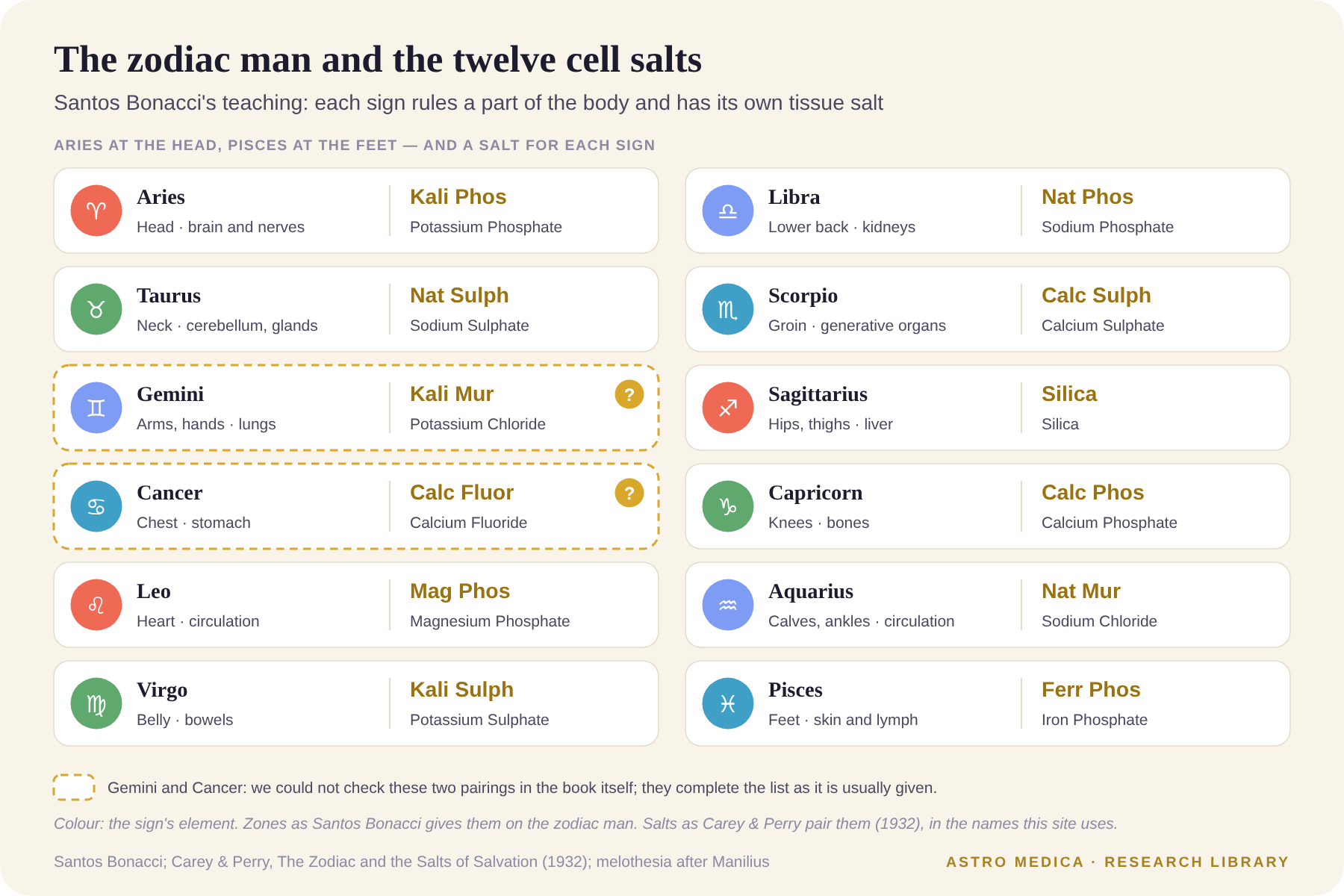
Santos Bonacci: the zodiac man and the twelve cell salts
In a long conversation with Gary, a fascia teacher, Santos Bonacci explains the zodiac man — Aries at the head, Pisces at the feet — and the twelve tissue salts George Carey paired with the signs. The zodiac man is genuinely ancient, and his pairings are Carey's. But Schüssler never found twelve salts in human ashes; a D6 tablet holds about a quarter of a microgram of salt, so it would take some 2.2 million Mag Phos tablets to match the magnesium in a handful of almonds; and we found no controlled trial of the salts, or of being “born deficient” in your sign's salt.
1st c. when Manilius set out the zodiac man in his poem Astronomica — the earliest full version
13 min read · 28 sources (5 peer-reviewed)
 ▶ 74 min
Members · preview open
Video research · Nutrition · Treatments & therapies · Exercise & movement · Mind & nervous system · Santos Bonacci · Medical astrology
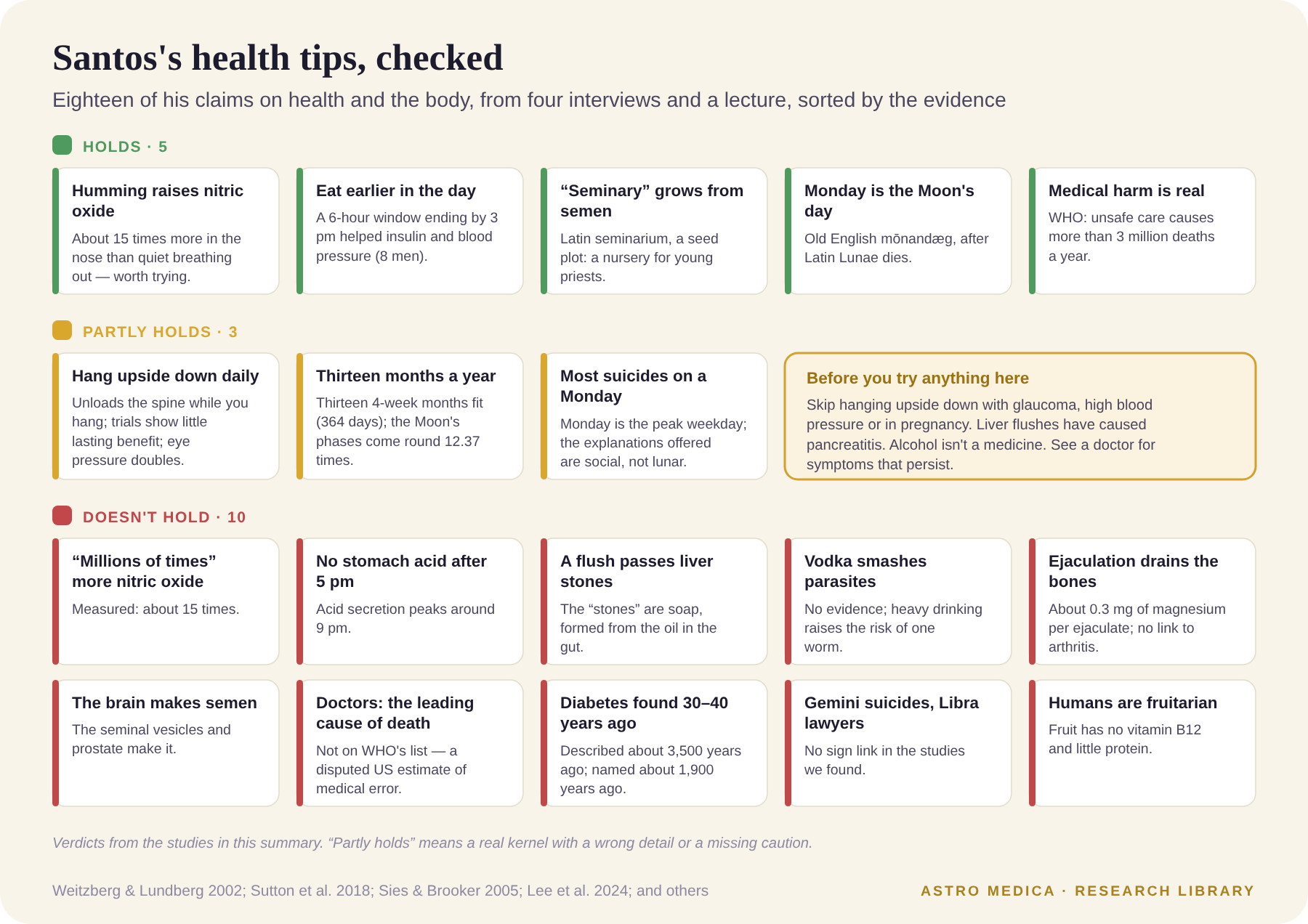
Santos Bonacci: health advice from the stars, checked
Santos Bonacci gives health advice as freely as astrology: hum for nitric oxide, eat before five, flush the liver at the new moon, hang upside down ten minutes a day, never spill the seed, live on fruit. Two of his tips stand up well — humming really does raise nitric oxide in the nose, about 15-fold rather than millions, and eating earlier in the day helped insulin and blood pressure in a small trial. Others need care or don't hold: flush “stones” are soap, alcohol doesn't clear parasites, hanging upside down doubles eye pressure, and a diet of fruit alone has no vitamin B12.
15× more nitric oxide in the nose while humming than breathing quietly out — not “millions”
19 min read · 49 sources (19 peer-reviewed)
 ▶ 71 min
Members · preview open
Video research · Planets & cycles · Santos Bonacci · Astrotheology
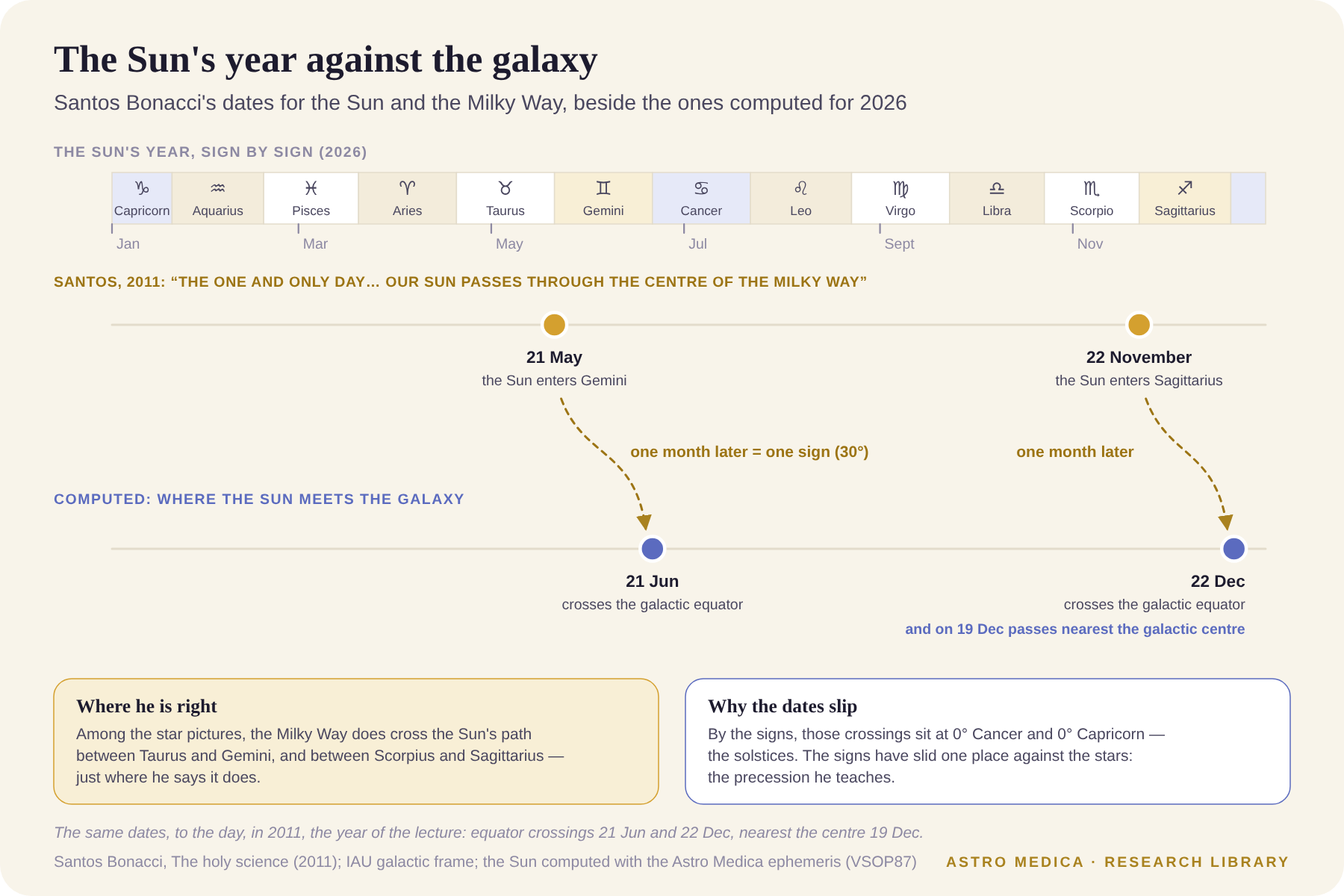
Santos Bonacci: the holy science
Santos Bonacci calls astrology and astrotheology “the holy science”: the Sun at the centre of every scripture and myth, read through three cycles — the day, the year and the great year of precession. Much of his history holds: Psalm 84:11 does call God “a sun and shield”, Bruno was burned in Rome in 1600, and Libra is older than the Greeks. His astronomy needs correcting: the great year is about 25,772 years, turned by the Sun and Moon pulling on the Earth's bulge, and Sirius is far too distant, and moving far too fast, to be our partner star.
25,772 years for one cycle of precession, from the measured rate of 50.288″ a year
18 min read · 38 sources (7 peer-reviewed)
 ▶ 110 min
Members · preview open
Video research · Planets & cycles · Nature & environment · Santos Bonacci · Astrotheology
Santos Bonacci: seeing everything through astrology
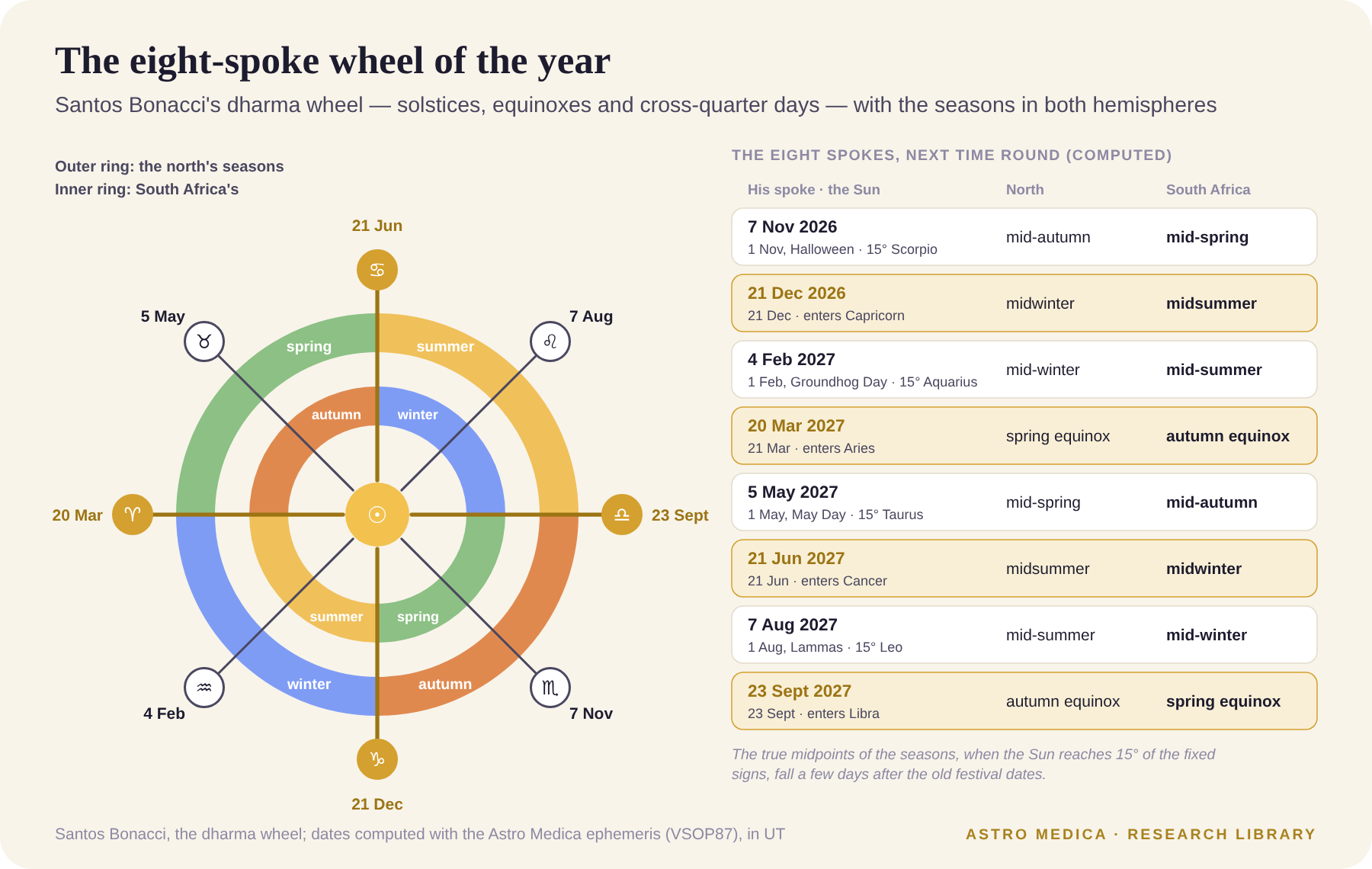
Santos Bonacci teaches astrology as a way of seeing: the sky as a 24-hour clock turning over the horizon, and the year as an eight-spoke wheel of solstices, equinoxes and cross-quarter days. His tools are sound — a chart is drawn from where we stand, as navigators and the old astrolabe makers drew the sky, and a sign does rise every two hours on average. But the average hides a lot in South Africa: over Johannesburg and Cape Town, Virgo and Libra rise in under an hour and a half and Taurus and Aquarius take well over two hours — the reverse of the north — and the wheel's seasons run six months out of step.
2 hours for a sign to rise — on average, as Santos says: twelve signs in a day
13 min read · 7 sources (3 peer-reviewed)
 ▶ 103 min
Members · preview open
Video research · Nature & environment · Planets & cycles · Santos Bonacci
Is the Earth flat? Checking the evidence
Santos Bonacci teaches that the Earth is a flat, stationary plane at the centre of the heavens, and the videos shared with his talk point to dozens of NASA and army papers that assume “a flat, non-rotating Earth”. The papers are real, but the phrase is a standard shortcut for short flights over a small area, and several of them say so. The Earth's turn has been measured directly — by Michelson and Gale in 1925, by ring lasers and by Foucault's pendulum, which turns the other way in South Africa — and simple checks anyone can do, from a lunar eclipse to the Southern Cross, agree: the Earth is a rotating globe.
0.230 of a fringe: the Earth's turn measured by Michelson and Gale in 1925, against 0.236 predicted — and 0 for a still Earth
16 min read · 31 sources (3 peer-reviewed)
 ▶ 79 min
Members · preview open
Video research · Planets & cycles · Mind & nervous system · Santos Bonacci · Astrotheology
Santos Bonacci: the language of the stars
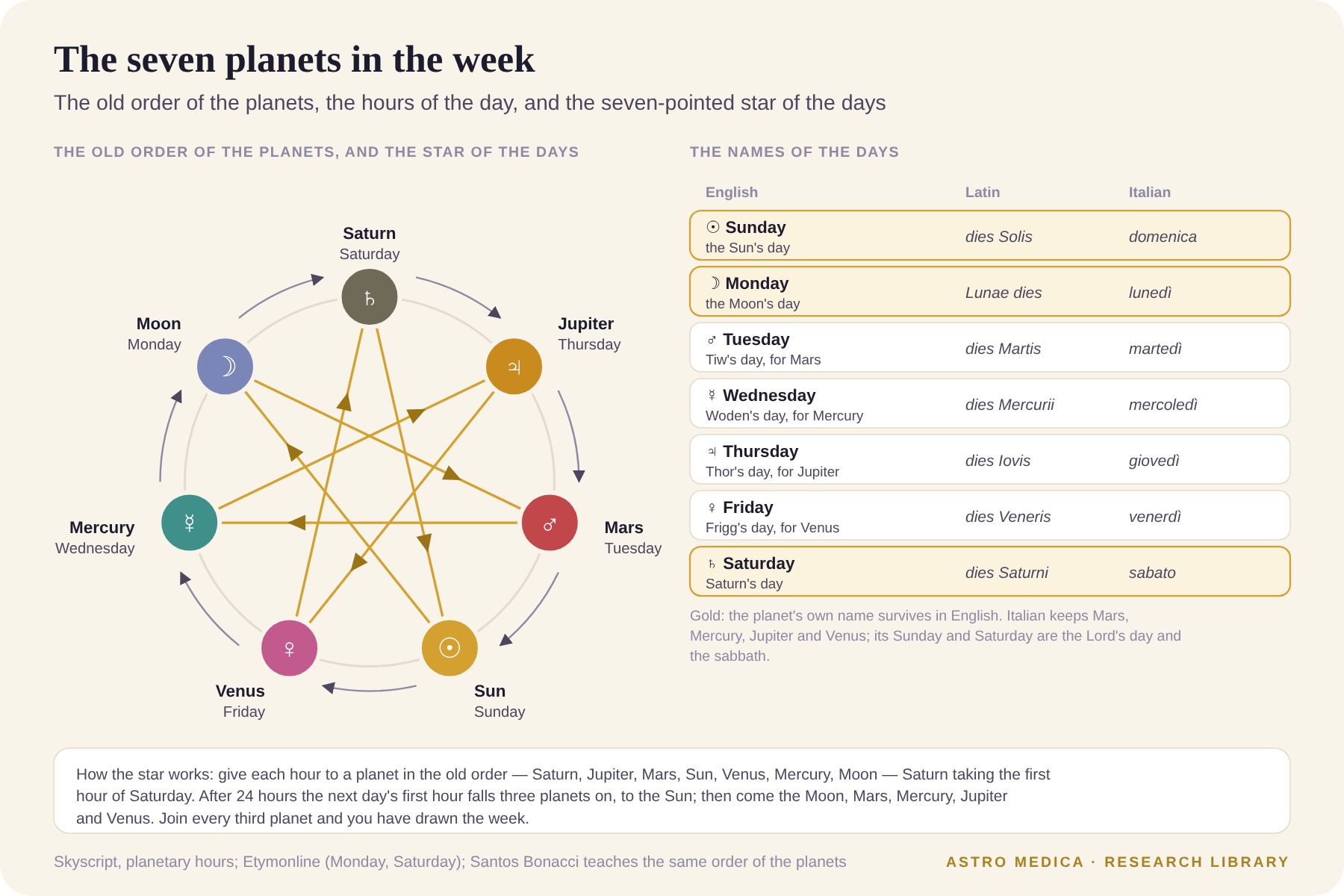
Santos Bonacci teaches that language is a spell: the alphabet is one long word, its letters carry numbers, and our words for days, months and gods carry the sky. Some of his word origins hold beautifully — month and Monday are the Moon's, the seven days are the seven planets, cardinal comes from the Latin for a hinge and Adam from the red earth. Many others are sound-alikes the dictionaries don't support: Jesus isn't “yes”, hour isn't Horus and planet means “wanderer”, not “plain” — though the real histories often carry the sky too.
7 days of the week, one for each of the seven visible planets — and the order of the days follows from the old order of the planets that Santos teaches
17 min read · 50 sources (2 peer-reviewed)
 ▶ 174 min
Members · preview open
Video research · Planets & cycles · Santos Bonacci · Astrotheology
Micah Denk: a blueprint in the sky
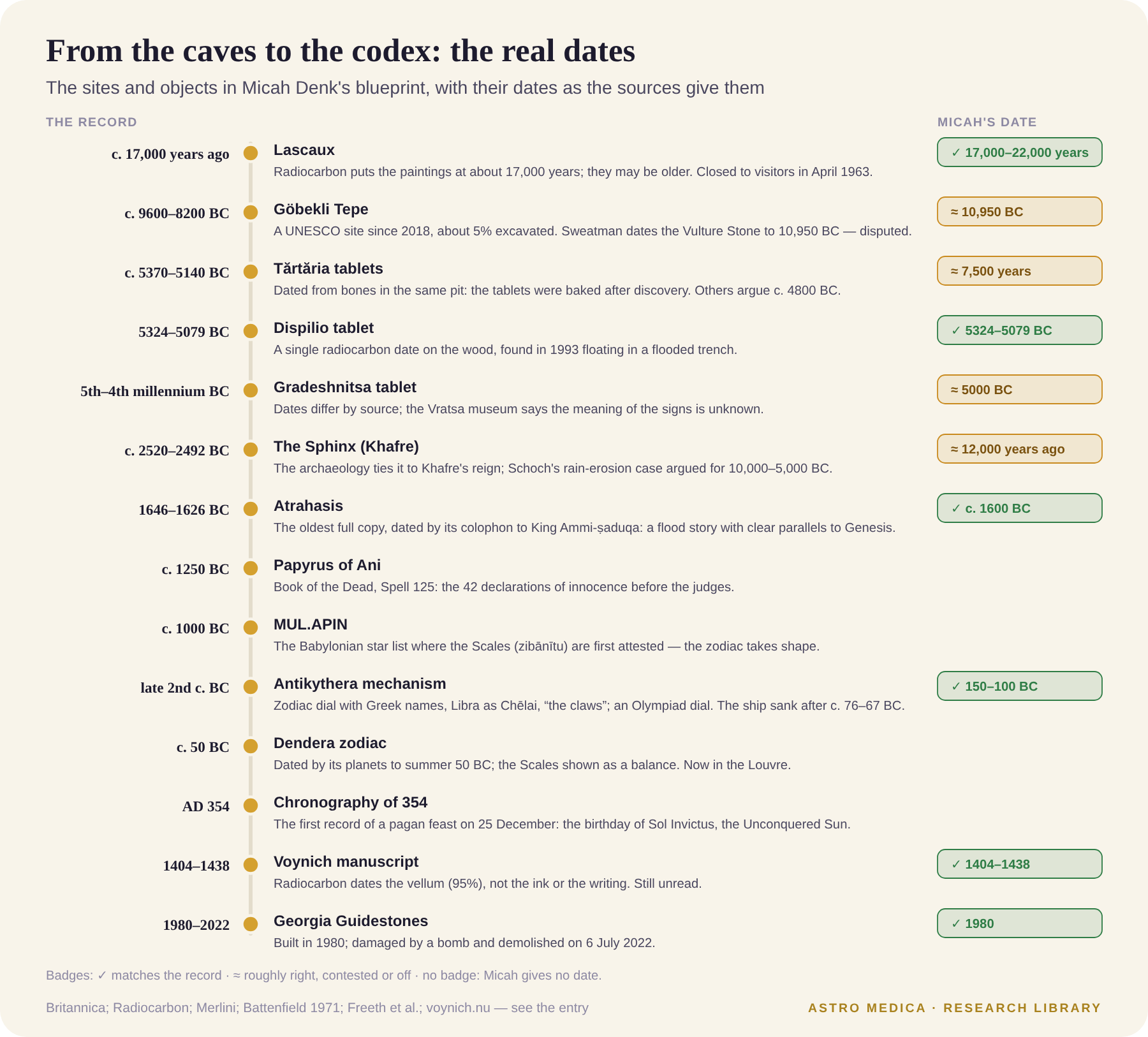
Micah Denk argues that from the cave paintings of Lascaux to the scriptures, people told one story — the Sun's year through the twelve signs — as poetry to remember the sky by. Much of his history holds: Lascaux is about 17,000 years old, his date for the Dispilio tablet is exact, the Atrahasis flood story is far older than Genesis, and the Antikythera mechanism does carry a zodiac dial. But the zodiac readings of the oldest sites and tablets are contested or unsupported, Turkey's olive trees were no cover-up, Mithras was born from a rock, and his sign patterns would appear in almost any list of animals.
c. 17,000 years: the radiocarbon age of the Lascaux paintings — his figure holds, and the art may be older
20 min read · 68 sources (11 peer-reviewed)
 ▶ 74 min
Members · preview open
Video research · Planets & cycles · Santos Bonacci
Santos Bonacci: the 2026 sky
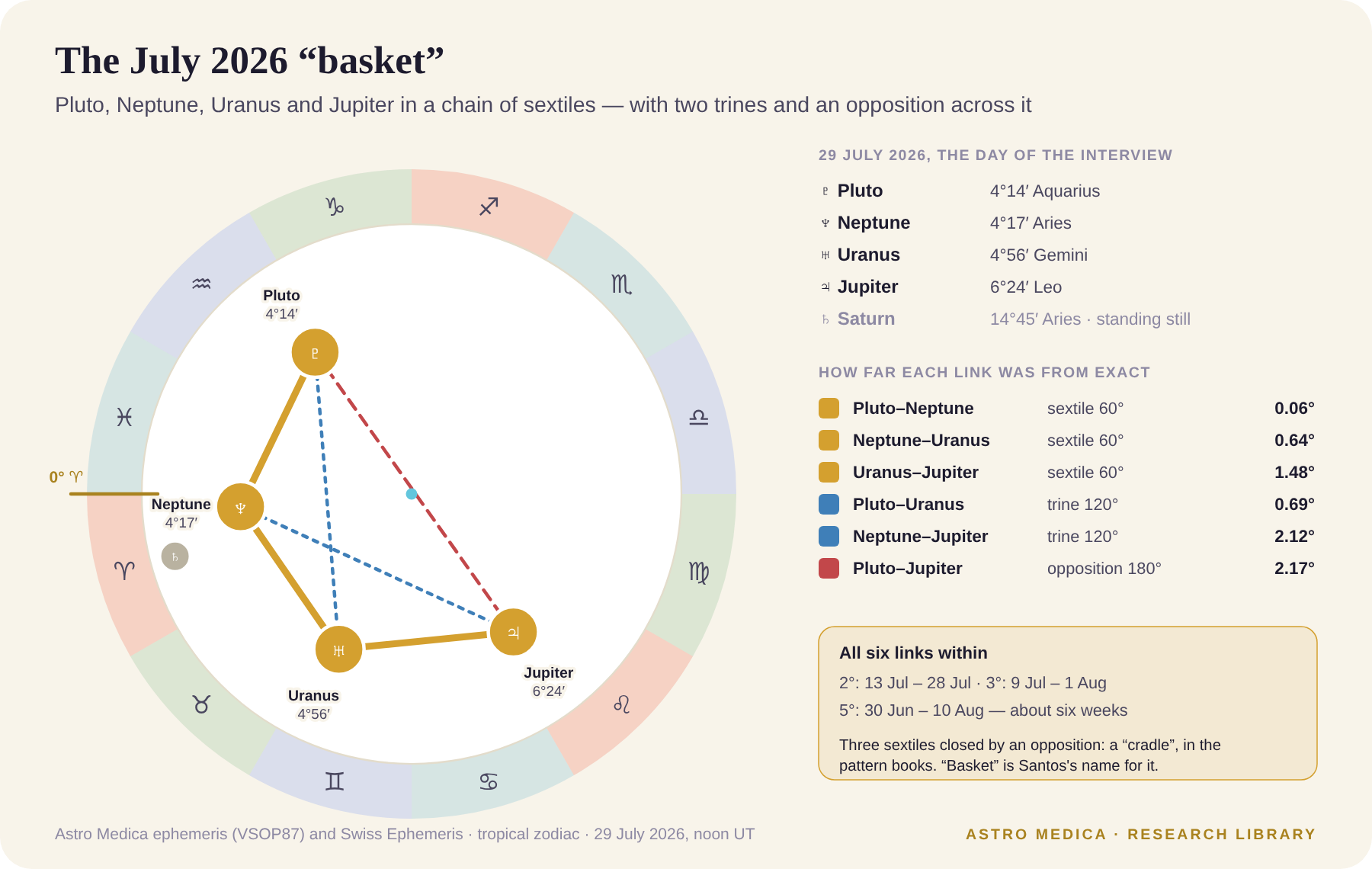
In an interview recorded on 29 July 2026, Santos Bonacci read the year through the chart of the world: Saturn and Neptune meeting at 0° Aries, Uranus moving into Gemini, and a July “basket” of Pluto, Neptune, Uranus and Jupiter 60° apart in a chain. The sky is as he describes. The conjunction was exact on 20 February 2026 at 0°45′ Aries, the closest to the Aries point since 1742 BC, and the July chain was within 2° of exact from 13 to 28 July. Two details need correcting: such meetings come every 1,150–1,470 years, not 800, and the last was in AD 878, three centuries before the Third Crusade.
0°45′ Aries where Saturn and Neptune met on 20 February 2026 — the first degree of the zodiac
11 min read · 7 sources (1 peer-reviewed)
 ▶ 54 min
Members · preview open
Video research · Planets & cycles · Mind & nervous system · Santos Bonacci · Medical astrology
Santos Bonacci: eclipses and the Moon
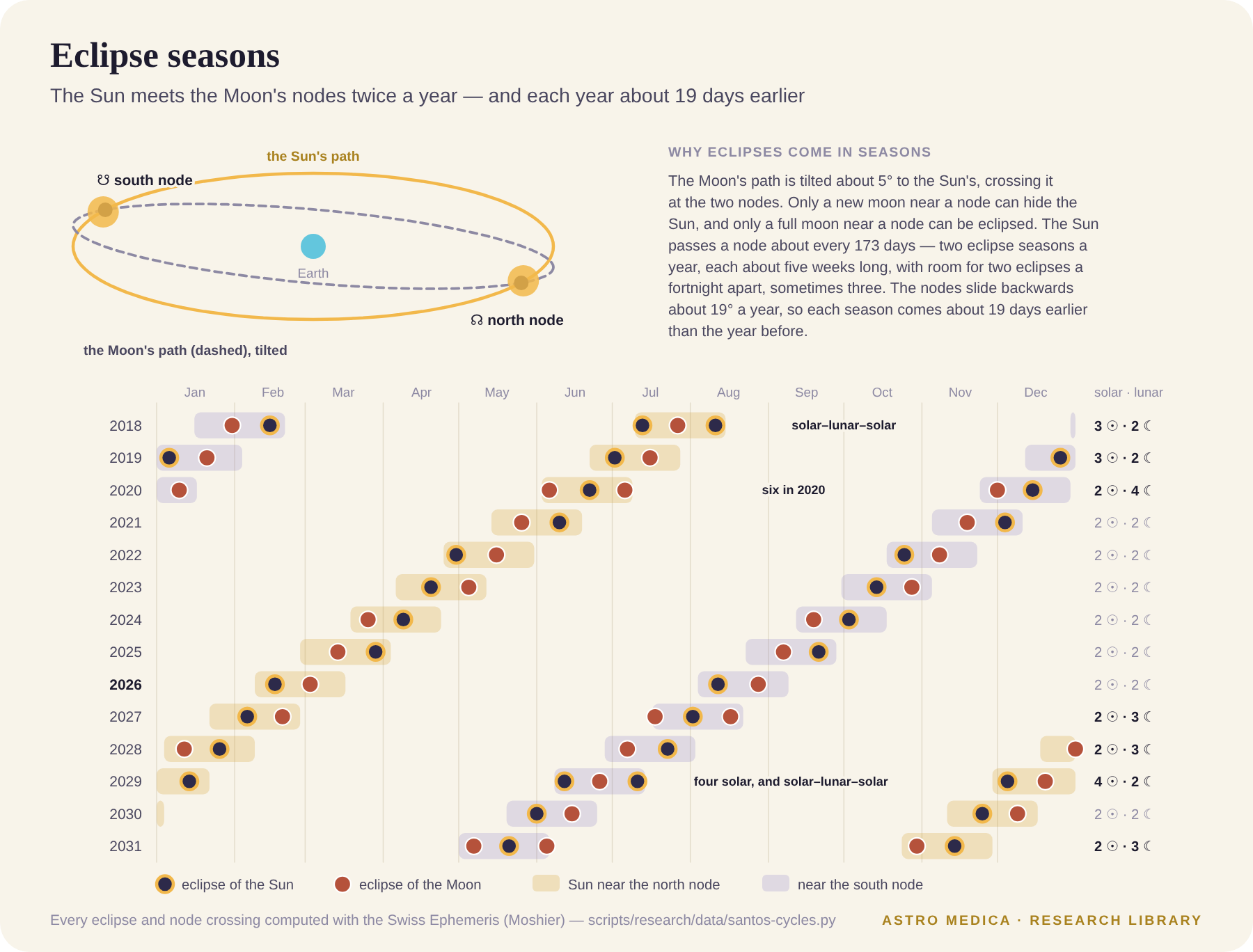
Santos Bonacci teaches the Moon's month, the Moon in the body and how to predict eclipses from the Moon's nodes. His method holds: eclipses come in seasons when the Sun meets the nodes, about six months apart and some 19 days earlier each year, and his 60 dark hours at new moon is a fair typical figure. His rules of thumb are a little too tight — a year can have up to five solar eclipses and seven in all, runs can go solar–lunar–solar, and the nodes take 18.6 years, not months, to go round. His teaching on the Moon and the body is tradition and experience, untested by sign; a Moon diary is the way to try it.
2–5 eclipses of the Sun every year — not two at most
14 min read · 19 sources (1 peer-reviewed)
The videos
Each one is summarised and fact-checked in its entry, with every claim timed to the video.
- Santos Bonacci and Gary on syncretism, the tissue salts and the body 105 min · checked in “Santos Bonacci: the zodiac man and the twelve cell salts” Read the summary → YouTube ↗
- Santos Bonacci on syncretism (interview, July 2026) 74 min · checked in “Santos Bonacci: health advice from the stars, checked” Read the summary → YouTube ↗
- The holy science, part 1 Santos Bonacci · 71 min · checked in “Santos Bonacci: the holy science” Read the summary → YouTube ↗
- How to see everything through the eyes of astrology, part 1 Santos Bonacci · 110 min · checked in “Santos Bonacci: seeing everything through astrology” Read the summary → YouTube ↗
- Santos Bonacci on the stationary, flat Earth 103 min · checked in “Is the Earth flat? Checking the evidence” Read the summary → YouTube ↗
- Santos Bonacci on the alphabet, numbers and language as a spell Santos Bonacci · 79 min · checked in “Santos Bonacci: the language of the stars” Read the summary → YouTube ↗
- Blueprint for this dimension revealed Micah Denk, reposted on Santos Bonacci's channel · 174 min · checked in “Micah Denk: a blueprint in the sky” Read the summary → YouTube ↗
- Santos Bonacci on syncretism, astrology and the sky of 2026 74 min · checked in “Santos Bonacci: the 2026 sky” Read the summary → YouTube ↗
- Santos Bonacci on predicting eclipses from the Moon's nodes 54 min · checked in “Santos Bonacci: eclipses and the Moon” Read the summary → YouTube ↗