Research Library · Video research · Planets & cycles
☉ Santos Bonacci project — every summary and video →Santos Bonacci: the 2026 sky
Astrotheologian Santos Bonacci reads the chart of the world for 2026 — Saturn and Neptune at 0° Aries, Uranus in Gemini and a rare July “basket” of four planets — checked against six thousand years of planetary positions.
15 October 2026 11 min read ▶ 74-min video 7 sources · 1 peer-reviewed
In brief
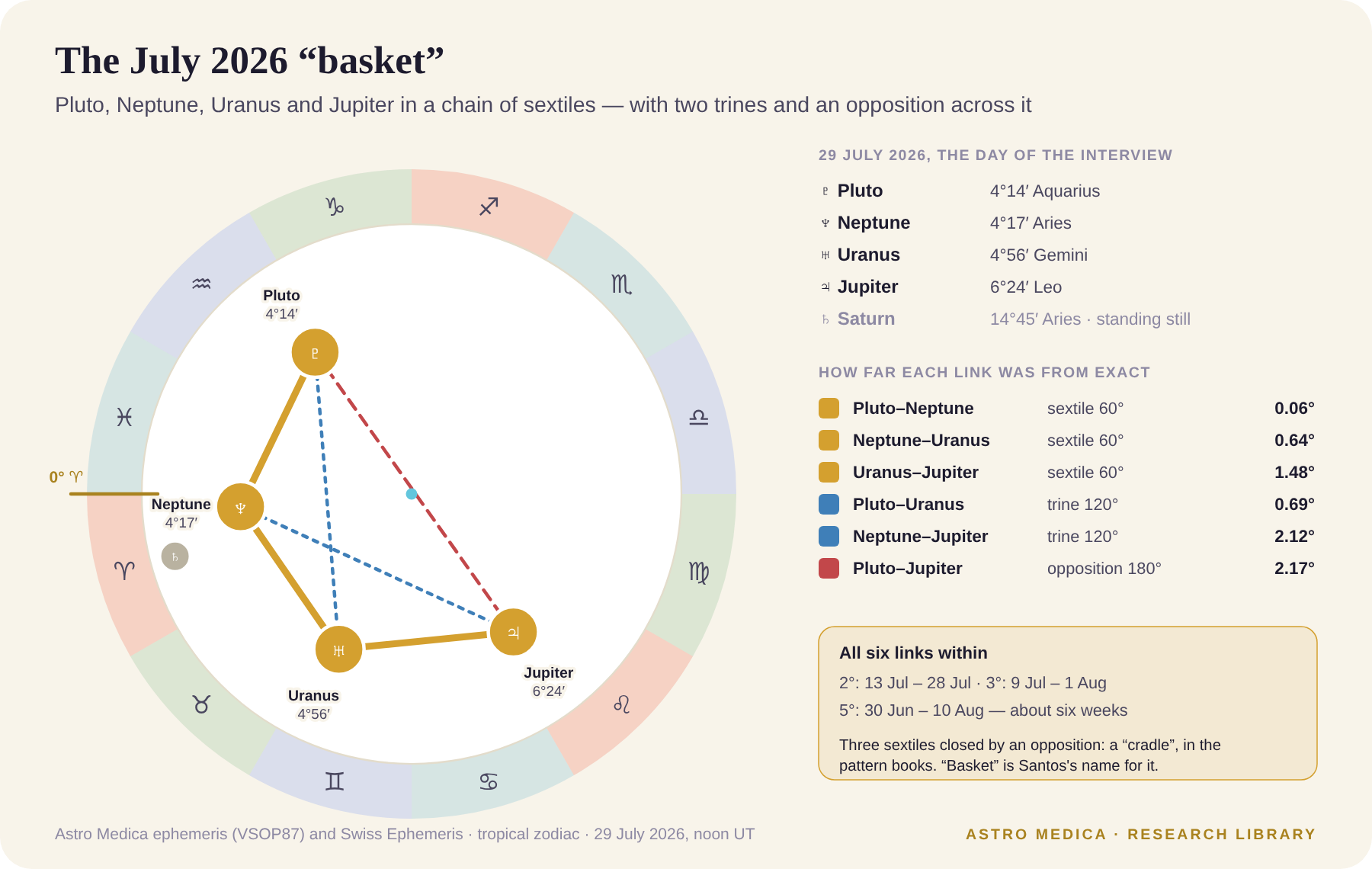
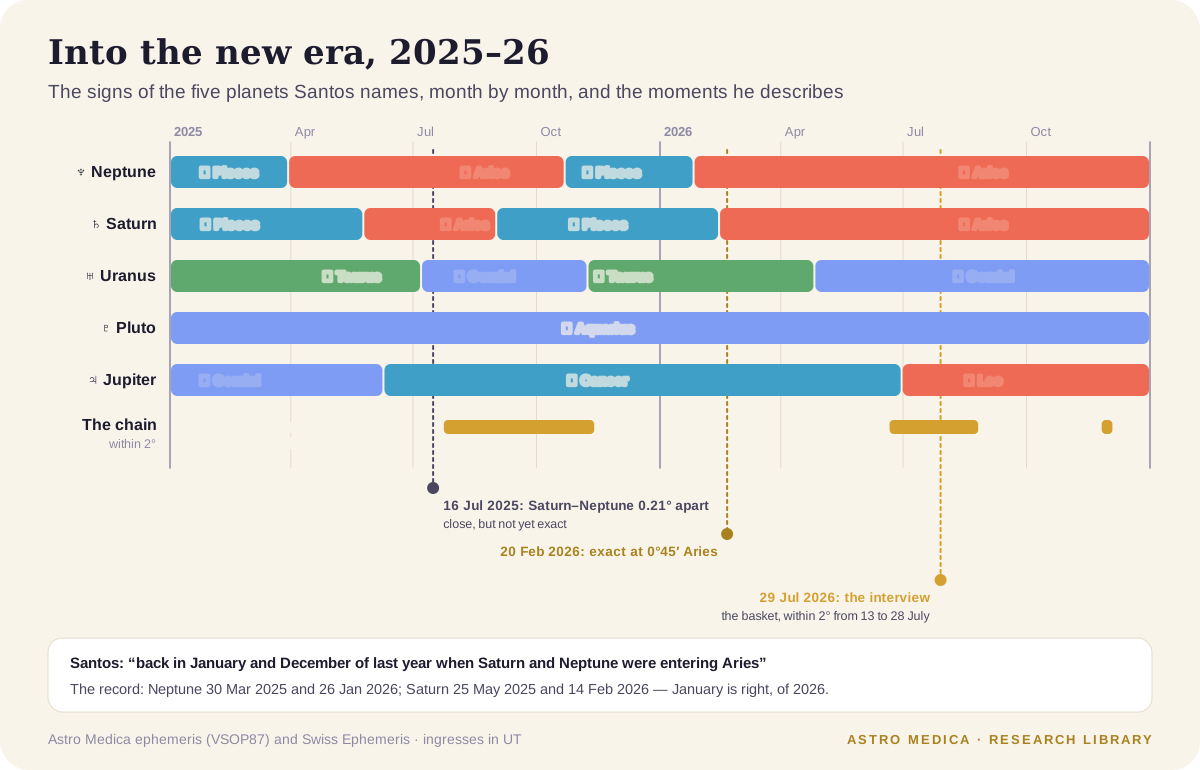
In an interview recorded on 29 July 2026, Santos Bonacci read the year through the chart of the world: Saturn and Neptune meeting at 0° Aries, Uranus moving into Gemini, and a July “basket” of Pluto, Neptune, Uranus and Jupiter 60° apart in a chain. The sky is as he describes. The conjunction was exact on 20 February 2026 at 0°45′ Aries, the closest to the Aries point since 1742 BC, and the July chain was within 2° of exact from 13 to 28 July. Two details need correcting: such meetings come every 1,150–1,470 years, not 800, and the last was in AD 878, three centuries before the Third Crusade.
Learn from the source
Santos Bonacci
Astrotheologian, astrologer and musician; founder of the Universal Truth School.
He reads scripture, myth, language and the body through the zodiac — “syncretism” — and his charts and graphics are on his school's site to study.
universaltruthschool.com ↗ Every summary of Santos Bonacci’s work →
Mundane astrology, read every day
The chart of the world
Asked about the age of Aquarius, Santos Bonacci turns from the birth chart to “the chart of the world”. Just as each of us has a natal chart, he says, the world has one, and by reading it — mundane astrology — “you can ascertain what's going to be coming up in the future… politically and everything.” He looks at it every day. When Saturn and Neptune were entering Aries he foresaw “a big reset”, and he says that what he saw has come to pass and is still unfolding. Forecasts of world events can't be tested from a single case, so this page sticks to the part we can check: the sky he describes.
For members
Read the whole summary
6 sections, 4 diagrams, the video with its chapters, 10 claims checked against the research, 7 sources with the names of the people who did the work and links to it — and downloads in PDF, Word, Excel and PowerPoint.
- 🔒 Saturn and Neptune at the Aries point
- 🔒 Another 800 years
- 🔒 The July basket
- 🔒 Saturn and Jupiter
- 🔒 Learn from Santos Bonacci
The Research Library is part of every paid plan: Crescent, Half Moon and Full Moon.
More in this project
- Santos Bonacci: the zodiac man and the twelve cell salts ▶ 105-min video · Astrotheologian Santos Bonacci on the zodiac in the body and the tissue salt for each sign — Schüssler's ashes, Carey's twelve pairings…
- Santos Bonacci: health advice from the stars, checked ▶ 74-min video · Astrotheologian Santos Bonacci's health tips from four interviews and a lecture — humming, supper before five, the liver flush, a daily…
- Santos Bonacci: the holy science ▶ 71-min video · Astrotheologian Santos Bonacci's 2011 lecture on “the holy science”: the Sun at the centre of scripture and myth, the day, the year and…
- Santos Bonacci: seeing everything through astrology ▶ 110-min video · Santos Bonacci's lessons on reading the sky as a 24-hour clock and a yearly wheel — the horizon, the ecliptic, the astrolabe and the…
- Is the Earth flat? Checking the evidence ▶ 103-min video · Santos Bonacci teaches that the Earth is a flat, stationary plane, and the videos shared with his talk point to NASA and army papers…
- Santos Bonacci: the language of the stars ▶ 79-min video · Astrotheologian Santos Bonacci on the alphabet as a spell, the numbers in our letters and the planets in our words and our week — his…
- Micah Denk: a blueprint in the sky ▶ 174-min video · Micah Denk's three-hour “Blueprint for this dimension”, reposted by Santos Bonacci: the zodiac read in Lascaux, Göbekli Tepe, the oldest…
- Santos Bonacci: eclipses and the Moon ▶ 54-min video · Astrotheologian Santos Bonacci on the Moon's month, the Moon in the body and how to predict eclipses from the Moon's nodes — his rules…