

Research Library · Planets & cycles · Video research
♇ Pluto project — every summary and video →The twilight of Pluto
John Michael Greer says Pluto's power rose with its discovery and is fading since its demotion, gone by 2036. We checked his history of planets that came and went, the interview's numbers, and the forecasts.
15 October 2026 15 min read ▶ 50-min video 39 sources · 11 peer-reviewed
In brief
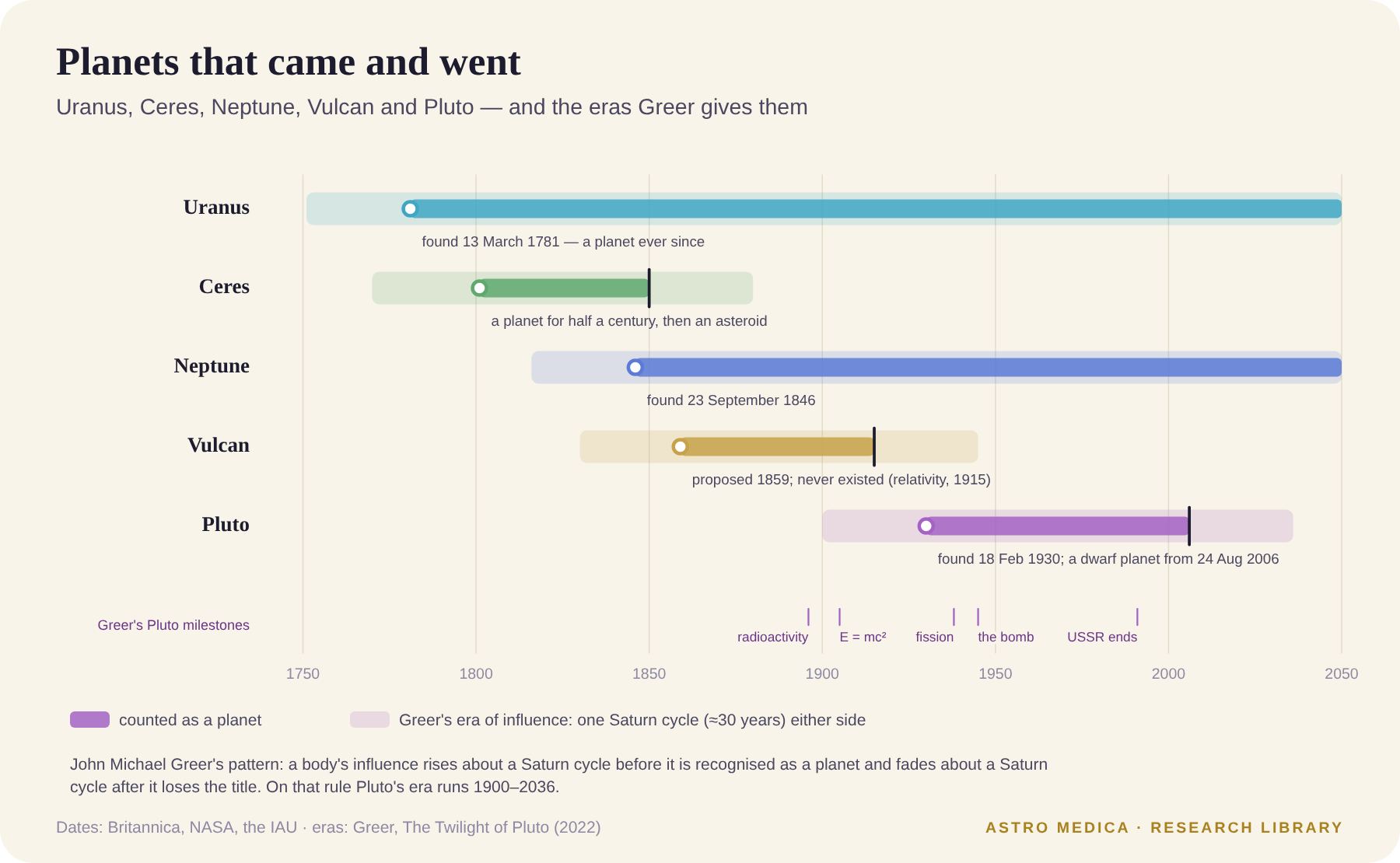
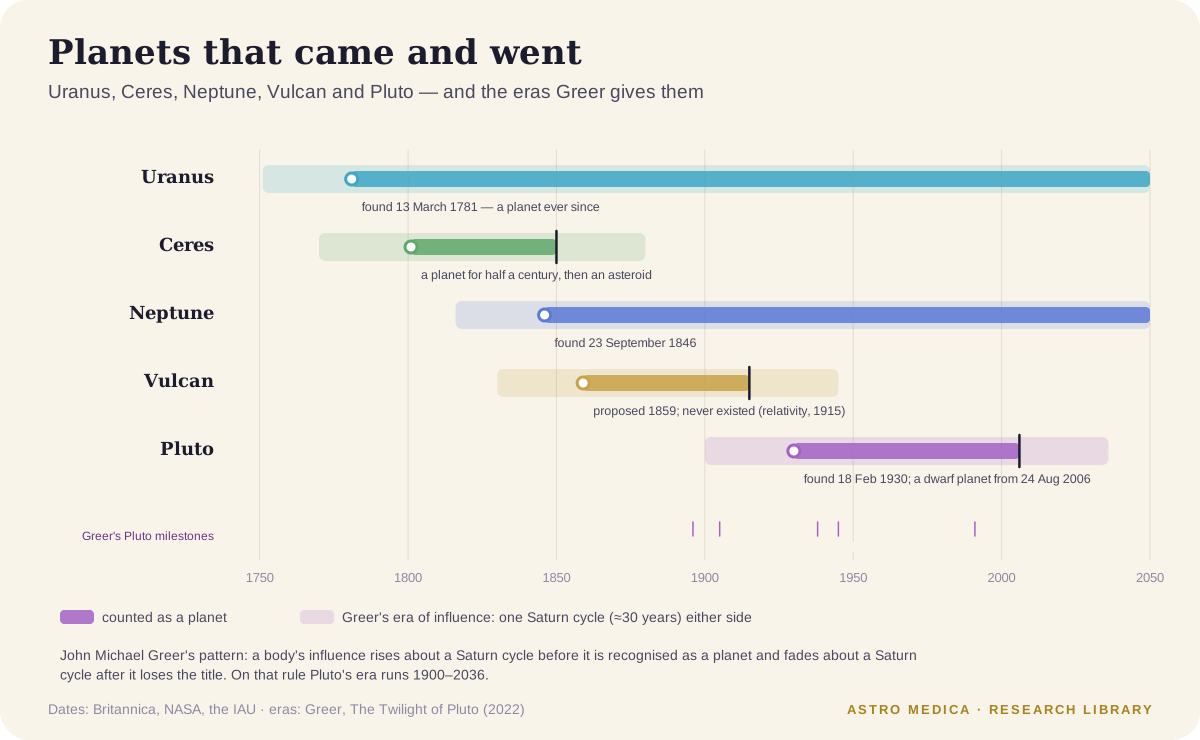
Astrologer John Michael Greer argues that a planet's influence rises about one Saturn cycle (30 years) before it is discovered and fades about one Saturn cycle after it loses the title. Pluto, found in 1930 and demoted to a dwarf planet in 2006, would then rule from 1900 to 2036 — the era of the atom, totalitarianism and the space race — and is fading now. His history of planets that came and went mostly checks out, and his claim that Pluto is the planet of overblown claims found support in the interview itself: three of its numbers were inflated, Apollo's share of the budget by more than three times. His forecasts for 2036 are the real test, and the first one, a disarmament treaty, is running the wrong way.
Greer's thesis
Planets that came and went
John Michael Greer, the writer, druid and astrologer, came to his idea from a Pluto transit that astrology books told him to dread — and that did nothing. Looking into it, he found that Pluto's status had shrunk ever since its discovery, and that astronomy had already promoted and demoted several bodies. His book The Twilight of Pluto (2022) proposes a rule: a planet's influence builds for about one Saturn cycle, roughly 30 years, before it is discovered, and fades over about one Saturn cycle after it loses the title. He stresses that the astronomers don't cause this: “the astronomers discovered the planets when the planets were ready to be discovered.”
For members
Read the whole summary
7 sections, 4 diagrams, the video with its chapters, 28 claims checked against the research, 39 sources with the names of the people who did the work and links to it — and downloads in PDF, Word, Excel and PowerPoint.
- 🔒 How small is Pluto?
- 🔒 The atom, the rocket and the 30-year rule
- 🔒 The numbers behind the hype
- 🔒 Neptune and Pluto: a cycle older than the discovery
- 🔒 What 2036 should look like
- 🔒 What the research says
The Research Library is part of every paid plan: Crescent, Half Moon and Full Moon.
More in this project
- Pluto out of bounds: the last time ▶ 27-min video · Rosie Finn's research on Pluto's journeys beyond the Sun's reach — tyrants in the north, revolutions in the south — checked across six…